Nestlé India Executive Board accepting the CRII Most Trusted Brand recognition

At a special session, the Executive Board at Nestlé India Ltd, led by CMD Suresh Narayanan (centre), received the CRII Most Trusted Brand Award from CRII Guild Members, including Abhilash Misra (Director, India and South Asia Outreach, Chicago Booth) and Anupam Kaul (Head, Institute of Quality, Confederation of Indian Industries); Nestlé India India was assessed as being amongst the top-three most-trusted consumer brands on quality in the FMCG industry in the CRII Annual National Consumer Survey; during the ceremony, Nestlé India was also inducted into the esteemed CRII Guild

Dabur India Ltd accepting the CRII Most Trusted Brand recognition

Sunil Duggal, Dabur CEO (second from right) and Byas Anand, Head Communications, Dabur India, accepting the CRII Most Trusted Brand Award, after Dabur India was assessed as being amongst the top-three most-trusted consumer brands on quality in the FMCG industry in the CRII Annual National Consumer Survey; during the ceremony, Dabur India was also inducted into the esteemed CRII Guild

Hindustan Unilever Ltd awarded and inducted into the CRII Guild

After the incorporation of HUL into the CRII Guild, Rajeev Batra, Group Head, Corporate Affairs, HUL, addressing the CRII board on behalf of HUL Chairman and Managing Director, Sanjiv Mehta, while accepting the CRII Most Trusted Brand Award; HUL was assessed as being amongst the top-three most-trusted consumer brands on quality in the FMCG industry in the CRII Annual National Consumer Survey

CRII and University of Chicago Booth School of Business sign a wide ranging MoU

After the momentous signing of the Memorandum of Understanding between CRII and the University of Chicago Booth School of Business, William Kooser (Associate Dean, University of Chicago Booth School of Business) accepts the Confederation Guild testimonial on behalf of Chicago Booth

Union Ministry of MSME, Government of India, being inducted into the Confederation Guild

Honourable Union MSME Minister Sh. Kalraj Mishra (second from right) accepting the CRII Guild testimonial in the presence of (extreme right) Bharath Visweswariah, Executive Director, UChicago Center, New Delhi, India, (extreme left) Kartik Narayan, Executive Director, CRII, and Param Khanna, Executive Director, CRII

Union Ministry of HRD, Government of India, being inducted into the Confederation Guild

(Centre to right) Honourable Union HRD Minister Dr. Ram Shankar Katheria, William Kooser (Associate Dean, University of Chicago Booth School of Business) and Abhilash Misra (Director, India & South Asia Outreach, University of Chicago Booth School of Business)

Foodpanda being inducted into the Confederation Guild

Foodpanda, represented by the Foodpanda India CEO Saurabh Kochhar (center), accepting the CRII Guild testimonial, in the presence of Kartik Narayan (left), Executive Director, Confederation of Retail Industries of India

PolicyBazaar being inducted into the Confederation Guild

PolicyBazaar.com, represented by co-Founder, CFO & COO Alok Bansal (right), accepting the CRII Guild testimonial, in the presence of Rushil Khanna, Executive Director, Confederation of Retail Industries of India

FabFurnish being inducted into the Confederation Guild

Ashish Garg, co-Founder FabFurnish.com, accepting the Confederation Guild testimonial on behalf of FabFurnish.com, in the presence of Param Khanna (left), Executive Director, Confederation of Retail Industries of India


R&B Special Feature: Why Companies May Be Overpaying For Web Search Ads (University of Chicago Booth School of Business)

Writer, Capital Ideas, Chicago Booth
Ed Robinson
Writer, Capital Ideas, Chicago Booth

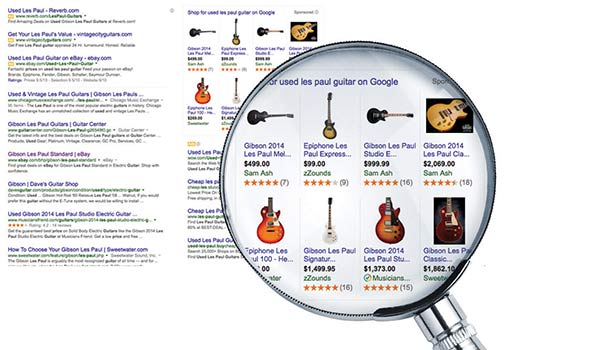
Paid internet search ads, also known as search-engine marketing (SEM), dominate online advertising. According to the latest figures available, advertisers spent $18.4 billion on paid search ads in 2013, or 43 percent of total US internet advertising revenue.

But many of those ad dollars being spent by well-known companies may be going to waste. A study of SEM’s impact suggests that while it might help bring in some new or infrequent customers, it doesn’t appear to have much impact on another important audience: frequent internet users seeking well-known brands.
why-companies-may-be-overpaying-for-web-search-ads

“For a site’s regular shoppers, SEM does not have a significant effect on their purchasing behavior,” write Chicago Booth’s Chris Nosko, Thomas Blake of eBay’s research labs, and University of California, Berkeley’s Steven Tadelis. Their findings indicate that much of the money being spent on SEM may be wasted on buyers who would have made the same purchases through other means rather than paid search advertising.

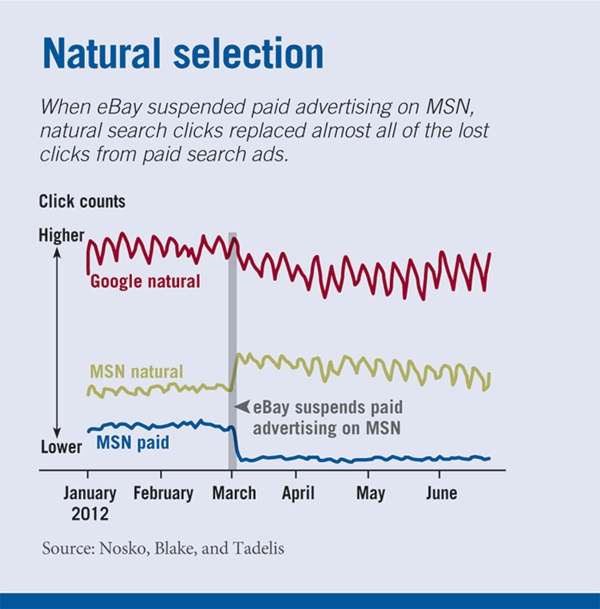
The researchers set up a series of experiments to study the effects of eBay’s SEM on revenues. In one experiment, eBay halted advertising alongside brand-related searches on the Yahoo and MSN search engines. The results reveal that for people whose searches included the term “eBay,” the ads for eBay had almost no effect—99.5 percent of the traffic that would have come to the site via the ads ended up there anyway.

“Shutting off paid search ads closed one (costly) path to a company’s website but diverted traffic to natural search, which is free to the advertiser,” the researchers write.
FC_Natural_Selection

But there are more than 100 million keywords that will trigger paid search ads, so in another experiment, eBay suspended paid search ads in 30 percent of US markets for 60 days. The researchers find that people making nonbrand-specific searches were only slightly more receptive to SEM. Paid search ads appeared to increase those people’s purchases by a statistically insignificant 0.66 percent.
Paid search ads did have some effect: they worked on people who hadn’t made recent purchases on eBay. People who made purchases after absences of 30 to 60 days rarely clicked on search ads, but the click-through rate rose for each month after that 60-day horizon, to the point that ad-influenced purchases became statistically significant.

And paid search ads had their biggest impact on first-time eBay buyers. The more users made purchases on the site, however, the less the impact: the statistical significance was close to zero for regular buyers.
“The experiment showed that the effectiveness of SEM is small for a well-known company like eBay and that the channel has been ineffective on average,” they write. “We find however, a significant positive effect of user search engine marketing on new user acquisition and in influencing purchases by new and less-frequent users.”

(The article was originally published on the Capital Ideas website: www.ChicagoBooth.edu/capideas; Connect with Capital Ideas on Facebook – www.facebook.com/BoothCapIdeas, Twitter – @BoothCapIdeas and YouTube – www.youtube.com/user/BoothThinking; Retail & Business is India’s leading retail publication)

facebooktwittergoogle_plusredditpinterestlinkedinmail

Leave a Reply