Nestlé India Executive Board accepting the CRII Most Trusted Brand recognition

At a special session, the Executive Board at Nestlé India Ltd, led by CMD Suresh Narayanan (centre), received the CRII Most Trusted Brand Award from CRII Guild Members, including Abhilash Misra (Director, India and South Asia Outreach, Chicago Booth) and Anupam Kaul (Head, Institute of Quality, Confederation of Indian Industries); Nestlé India India was assessed as being amongst the top-three most-trusted consumer brands on quality in the FMCG industry in the CRII Annual National Consumer Survey; during the ceremony, Nestlé India was also inducted into the esteemed CRII Guild

Dabur India Ltd accepting the CRII Most Trusted Brand recognition

Sunil Duggal, Dabur CEO (second from right) and Byas Anand, Head Communications, Dabur India, accepting the CRII Most Trusted Brand Award, after Dabur India was assessed as being amongst the top-three most-trusted consumer brands on quality in the FMCG industry in the CRII Annual National Consumer Survey; during the ceremony, Dabur India was also inducted into the esteemed CRII Guild

Hindustan Unilever Ltd awarded and inducted into the CRII Guild

After the incorporation of HUL into the CRII Guild, Rajeev Batra, Group Head, Corporate Affairs, HUL, addressing the CRII board on behalf of HUL Chairman and Managing Director, Sanjiv Mehta, while accepting the CRII Most Trusted Brand Award; HUL was assessed as being amongst the top-three most-trusted consumer brands on quality in the FMCG industry in the CRII Annual National Consumer Survey

CRII and University of Chicago Booth School of Business sign a wide ranging MoU

After the momentous signing of the Memorandum of Understanding between CRII and the University of Chicago Booth School of Business, William Kooser (Associate Dean, University of Chicago Booth School of Business) accepts the Confederation Guild testimonial on behalf of Chicago Booth

Union Ministry of MSME, Government of India, being inducted into the Confederation Guild

Honourable Union MSME Minister Sh. Kalraj Mishra (second from right) accepting the CRII Guild testimonial in the presence of (extreme right) Bharath Visweswariah, Executive Director, UChicago Center, New Delhi, India, (extreme left) Kartik Narayan, Executive Director, CRII, and Param Khanna, Executive Director, CRII

Union Ministry of HRD, Government of India, being inducted into the Confederation Guild

(Centre to right) Honourable Union HRD Minister Dr. Ram Shankar Katheria, William Kooser (Associate Dean, University of Chicago Booth School of Business) and Abhilash Misra (Director, India & South Asia Outreach, University of Chicago Booth School of Business)

Foodpanda being inducted into the Confederation Guild

Foodpanda, represented by the Foodpanda India CEO Saurabh Kochhar (center), accepting the CRII Guild testimonial, in the presence of Kartik Narayan (left), Executive Director, Confederation of Retail Industries of India

PolicyBazaar being inducted into the Confederation Guild

PolicyBazaar.com, represented by co-Founder, CFO & COO Alok Bansal (right), accepting the CRII Guild testimonial, in the presence of Rushil Khanna, Executive Director, Confederation of Retail Industries of India

FabFurnish being inducted into the Confederation Guild

Ashish Garg, co-Founder FabFurnish.com, accepting the Confederation Guild testimonial on behalf of FabFurnish.com, in the presence of Param Khanna (left), Executive Director, Confederation of Retail Industries of India


R&B Special Feature: Online vs. Offline: Where Do Chinese Consumers Really Win? (China Europe International Business School)

Slick images of celebrities fill billboards across China right now, urging consumers to visit the major e-commerce platforms like Alibaba’s T-mall, jd.com, and yihaodian on November 11 to snap up the one-day flash bargains that will be on offer for Single’s Day. This Chinese shopping holiday, created by e-commerce giant Alibaba in 2009, has become a multi-billion dollar consumption frenzy that now dwarfs Black Friday and Cyber Monday in the US. Alibaba posted record-breaking sales of $9.3 billion on November 11, 2014, with the highest sales volume reportedly for gadget and home appliance purchases made through the official Xiaomi, Huawei and Haier shops on Alibaba’s T-mall platform.

As these numbers show, online shopping is increasingly popular in China. The China E-Commerce Research Center (CECRC) said that consumer e-commerce grew by almost 50% year-on-year to RMB 2.8 trillion ($450 billion) in 2014, and it projects rapid growth will continue this year as well.

But is online shopping always a bargain? A recent pricing survey by CEIBS Associate Professor of Marketing Yi Xiang shows that the average online prices for consumer goods in China are only 8% lower than their offline prices when there are no sales promotions. In fact, in some popular categories consumers will actually find much lower prices if they make their purchase at a traditional bricks-and-mortar retail outlet. Meanwhile in many other categories, prices are the same both online and offline.

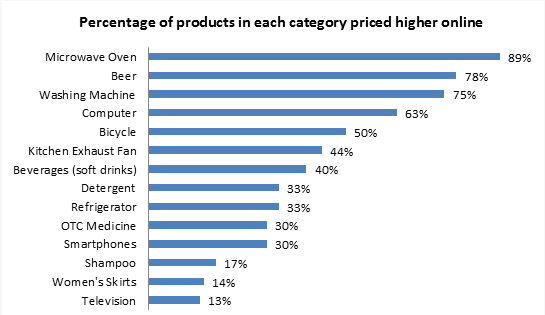
Consumers may find Professor Xiang’s findings helpful when making up their Single’s Day shopping lists. They may explain why there was such a high volume of gadget and home appliance sales during last year’s Single’s Day. Typically many of these products are more expensive when purchased online. For example he found that 89% of microwave ovens, 75% of washing machines, 63% of computers, and 44% of kitchen exhaust fans are usually priced higher online. Therefore online sales promotions for these items would be appealing to shoppers who will feel as if they are getting a bargain.Screen Shot 2016-03-11 at 5.15.10 pm
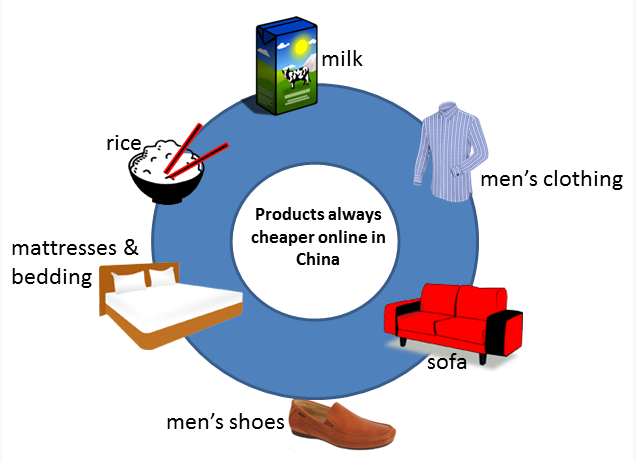
There are, however, products that are always cheaper to buy online. Professor Xiang found this to be the case for air conditioners, beds, sofas, and men’s clothing. So it is unlikely there will be many Single’s Day bargains for items in these categories as their prices are already low online.
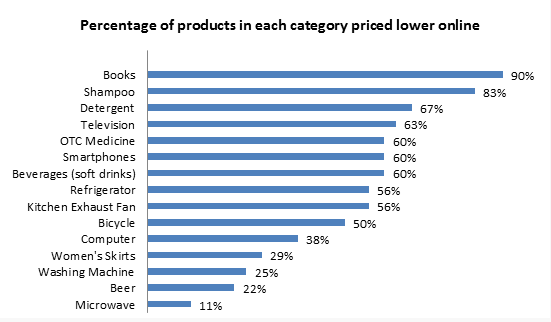
Single’s Day shoppers may also want to relax a bit if they are looking to buy books, over-the-counter medicines, refrigerators, televisions or smartphones, as Professor Xiang found that the majority of these goods are usually priced lower online anyway. So, again, less chance of prices going any lower on 11/11.
To develop his pricing survey, Professor Xiang followed the China Statistics Bureau’s Consumer Price Index (CPI) approach. China’s CPI has more than 200 types of consumer goods – he looked at those with a high sales volume that are readily available both online and offline. He compared the prices for products of the same brand/make/model/size sold online through platforms like T-mall, yihaodian and jd.com with their offline prices in retail outlets like Wal-mart, Carrefour, and Suning. His data set excluded promotions, and sales channels with a reputation for offering counterfeit goods.

“Some people think you always get a better deal online, but that’s not really the case,” he says. Professor Xiang’s academic curiosity on this price differential was sparked by a late night craving for sunflower seeds. “I bought a new brand of sunflower seeds one night, from Family Mart, and I really enjoyed them. To avoid future midnight shopping trips I decided to order a couple boxes online to keep at home. Immediately after I placed the order and paid, I thought about the price. They were RMB 11.8 online, but only RMB 11.3 at Family Mart,” he says. Though he admits that this research hasn’t caused him to significantly change his shopping habits, he has made one slight adjustment. “I don’t buy sunflower seeds online anymore,” he says with a smile.

(Printed in CRII’s Retail & Business with permission from China Europe International Business School; Retail & Business is India’s leading retail publication)

facebooktwittergoogle_plusredditpinterestlinkedinmail

Leave a Reply